
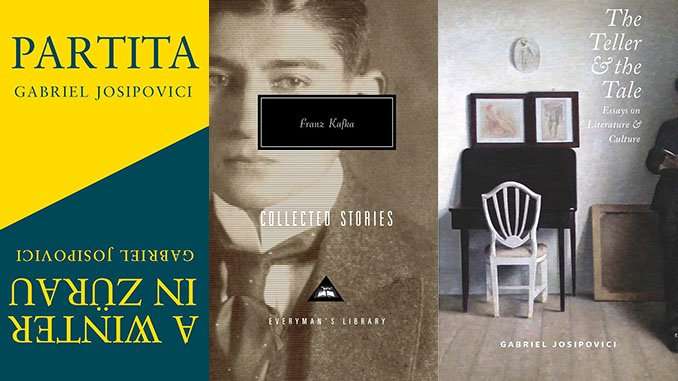
BookBlast review of Partita & A Winter in Zürau by Gabriel Josipovici (Carcanet)
Partita & A Winter in Zürau are an unsettling, exploratory and seductive read which challenge the essential strangeness of existence. Gabriel Josipovici is a distinguished figure in contemporary British letters for good reason. Josipovici’s highly informed critique of literary traditions and his experimental approach to fiction challenge conventional narrative forms. His literary criticism stands out for its advocacy of modernist traditions and its rigorous questioning of postmodern and contemporary literary trends. The hallmark of his own works comprises a unique blend of literary theory, philosophical reflection and a commitment to the way in which literature can convey complex ideas about existence, creativity and la comédie humaine.
Two books in one, Partita & A Winter in Zürau is both a novel and an exploration of eight crucial months in the life of one of the greatest writers of the twentieth century: Franz Kafka. The protagonist of each narrative is a man on the run: Michael Penderetzky a.k.a. Penderecki from Karim, an enraged knife-wielding killer; and Franz Kafka from an internal killer, tuberculosis.
Josipovici’s novel, Partita, is written almost entirely in dialogue and is wonderfully weird set within a haunting, minimalist void, creating a sense of isolation and existential angst. Its ambiguity and lack of clear answers provokes leftfield thoughts and emotions in the reader.
“Now I will explain, the man says: If I come tomorrow and you are here, I will kill you.” These words precipitate Penderecki’s frantic flight — first to his friend Giles, then to Gerry where he has a quick fling with Sue (Mike has an eye for pretty women which triggers trouble) . . . across the Channel to Xavier in Paris, and on to Nice where he beds down with a sultry songstress who sings Yves Montand and Juliette Gréco to an enraptured audience at Pépito bar in Nice Old Town. She plays cat and mouse with Mike leading him a merry dance to Genoa, Domaso on Lake Como, the Alpine resort Sils Maria and on . . . Will Mike ever stop running and return home? Or is he in fact searching for purpose in an unfathomable universe? The absurdity of his situation is oddly humorous even if bleak. An atmosphere of frustration, futility and struggle develops and the reader is left with a feeling of unsettling tension and bemused amusement.
A Winter in Zürau is an incisive analysis and account of Franz Kafka’s time spent in Zürau in 1917-1918, where his youngest sister Ottla owned a farm, after he was diagnosed with tuberculosis. This period of solitude and recovery gave Kafka an opportunity to reflect deeply, free from the demands of his women, his job and the distractions of city life in Prague. As he recovered from the shock of the night of 29 August 1917 — “I had a violent fit of coughing and spat up a stream of blood” — he had time to explore ideas and to drift in nature. And he wrote a series of short, cryptic fragmentary reflections on metaphysical, religious and existential themes known as The Zürau Aphorisms.
The reader is with Kafka through Josipovici’s eyes and brilliant mind from September 1917 through to January-April 1918 as he contemplates existential themes with clarity and depth, goes on walks in local villages, is woken up by mice one night provoking disgust and misery leading to him getting a cat, (which is not irritation-free either, “It’s a considerable nuisance to undress in front of her, do one’s exercises and go to bed.”). References to his stories and novels, what writing actually is or is not, letters with his supposed fiancée, his publisher, his friend Max Brod among others, and much more, are woven into the narrative with extensive quotes and insights. And there are, of course, the famous aphorisms.
There is both a clarity and an ambiguity to the whole narrative. What is actually being said, what is really going on? A French saying came to mind as I was reading, “Un train peu en cacher un autre” / “One train can be hiding another”. In other words, “it” is more difficult to understand and involves much more than you thought at first glance.
There are no easy answers and there is much uncertainty in life, and good literature can probe beyond surface realities to confront the complexity of being. Reading both Kafka and Josipovici is essential in a complacent world driven by economic rather than creative imperatives, in which simple easy-peasy lemon squeezy answers tend to be favoured.
BookBlast Interview with Gabriel Josipovici
BUY Partita & A Winter in Zürau
BUY Collected Stories, Franz Kafka
BUY Whatever Happened to Modernism?
The copyright to all the content of this site is held by the individual authors and creators. All rights reserved. Enquiries: please use the contact form


